By: AJ Witte
The Genpei war was a civil conflict during the late Heian period between the Minamoto and the Taira clans for control over Japan. This war eventually led to the political downfall of the Taira clan and the rise to power and creation of the first shogunate, the Kamakura Shogunate. During this time of strive we also saw the rise of the Japanese military class, the samurai. The samurai were among the most important and powerful warriors on the battlefield. They were equipped with a wide range of weapons and armor, which allowed them to fight effectively in a variety of situations.
The primary weapon of the samurai was the katana, a curved, single-edged sword that was designed to have a masterful cutting edge with the ability to be used as a thrusting if needed. The katana was the symbol of the samurai class and to this day is one of the most well-crafted weapons of all time. The blade was made from high-quality steel, which was folded and tempered multiple times to create a strong, durable, and sharp blade. The katana was worn on the left side of the samurai’s waist in what is known as the saya, or the traditional Japanese sheath. The saya is traditionally made from a lightweight lacquered wood, decorated to match the armor of its wielder. The katana would face upwards in the saya, which allowed the samurai to draw it quickly and efficiently.
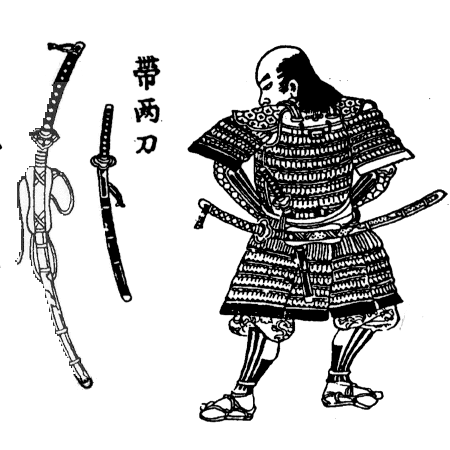
In addition to the katana, samurai often carried a shorter sword known as a wakizashi. The wakizashi was also worn on the left side of the waist within the waist sash, or the Uwa-obi or himo, and was used for close-quarter combat or as a backup weapon. The reason why a samurai’s weapons were held at the left side was to allow for the ability to unsheathe the blade across the users body in a wide sweep, while pushing the saya back out of the way. For this reason, all samurai were right-handed sword wielders. The combination of the katana and wakizashi was known as a daisho, translated to “big-little” which relates to the “big” blade, the katana, and the “little blade”, the wakizashi.
The samurai were also skilled with ranged weapons, such as the yumi, the Japanese longbow and the yari, a spear type weapon. The yumi was an essential weapon for samurai archers and was made from bamboo and hemp. It had a range of up to 300 meters. Samurai were proficient both planted on the ground as well as using their yumi on horseback. The yari was a spear that was used for thrusting and piercing. It was particularly useful for breaking through enemy lines and disrupting formations.
The samurai also used a variety of other weapons, including the naginata a very large war glaive and the tachi, a longer form of the katana. These weapons allowed the samurai to adapt to different situations and engage in a variety of combat styles.
The samurai were also known for their distinctive and effective armor which offered excellent protection from their enemies. The most common type of armor worn by samurai during the Genpei War was the o-yoroi. The o-yoroi was a full suit of armor that consisted of 6 major pieces referred to as, “hei-no-rokugo”, the six articles of arms. It consisted of the dō, the cuirass, the kabuto, the helmet, menpo, mask, kote, the armored sleeves, sune-ate, greaves, and the hai-date, thigh armor. The helmet was often adorned with a crest, which indicated the samurai’s allegiance or rank. The cuirass was made from iron or leather and protected the samurai’s torso, while the greaves protected the legs. The armor was designed to be lightweight and flexible, allowing the samurai to move quickly and easily on the battlefield.

Samurai also carried a variety of other essential items, such as a tessen, an unassuming iron fan which would be used for self defense as a last resort. The tessen carries itself into modern times as there is an entire martial art dedicated to its use as a defensive weapon called tessen-jutsu. Beyond the tessen, samurai wore a tanto, a small blade which while may not have been used for combat would have been used for many of the more boring activities a samurai may face, such as clearing small brush or collected wood for camp. Finally, samurai would carry a small box called an inro, which was used to hold personal items such as money, medicine, or small tools.
Another important piece of equipment for the samurai was the horo, which was a banner or cloak worn on the back of the armor. The horo was made from silk or other decorative fabrics and was used to display the samurai’s clan emblem or other symbols. The horo served a dual purpose of providing protection from arrows and also served as a way for the samurai to be identified on the battlefield.
The loadout of samurai during the Genpei War consisted of a variety of weapons, armor, and other equipment that were essential for their success on the battlefield. The samurai were highly skilled warriors who were trained in various martial arts and combat techniques, and their equipment reflected their expertise and experience.
Sources:
https://www.smai.com.au/blogs/news/katanas-explained
https://www.martialartswords.com/blogs/articles/what-is-daisho
https://en.wikipedia.org/wiki/%C5%8C-yoroi
https://www.ancient-origins.net/artifacts-ancient-technology/tessen-0010670

